This message draws on psychological first aid (PFA) and the United Nations’ intervention pyramid for mental health and psychosocial support (MHPSS).
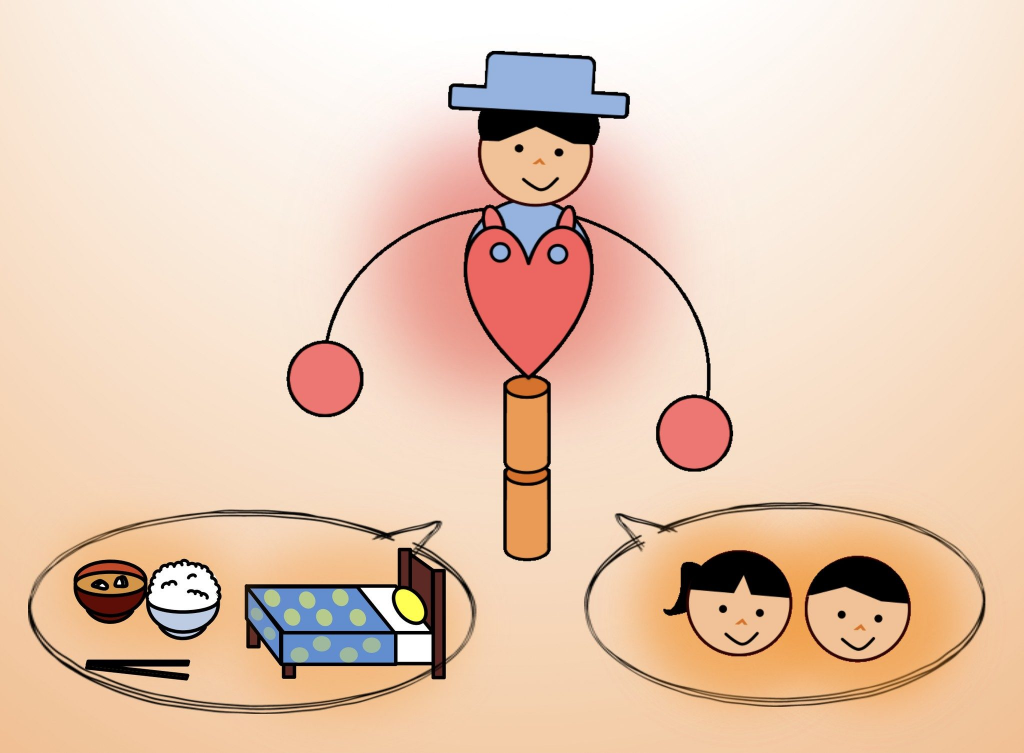
It is natural to feel unsettled after a shock. Like a balancing toy that sways after being moved, your feelings may fluctuate for a while before settling.
- Keep your usual routines as much as possible. Sleep and meals are especially important.
- Stay connected to people you can talk to when you need help.
If watching coverage is distressing, take a break from television and the internet. Muting topics on social media can help. If you still feel unsettled, you can talk to someone through LINE or other chat services. The online mental health shelter also shares ways to calm yourself and information on where to seek support.
Children can react in a similar way. Keep familiar routines where you can, and give children a place where they feel safe and secure.
For children’s reactions in emergencies, see Psychological First Aid for Children. Appendix E of the Japanese edition of Psychological First Aid: Field Operations Guide, second edition provides practical advice for caregivers.
It would help if news coverage also shared ways to offer support, manage stress and decide how much news to follow. In a situation that is difficult to control, I hope that taking time to settle ourselves will help us do what we can to support early assistance, recovery and reconstruction. I hope that people affected by the disaster can reach safety and find some peace soon.
Guidance from the University of Tsukuba
The Department of Disaster and Community Psychiatry at the University of Tsukuba compiled mental health guidance for people affected by the earthquake, people following the news and people providing support. The main points are as follows.
For people affected or evacuated
- Once you are somewhere safe, take time to relax.
- Organize your thoughts and decide what needs doing first.
- Take care of basics, including sleep and meals.
- Communicate and look after your relationships.
For people following the news
Watching the news can be stressful in itself.
- Keep viewing to a minimum. Avoid watching repeatedly, for long periods, or in the background.
- Check what the information says and where it comes from. Rumors can increase anxiety.
- If you are struggling with your mental health, avoid distressing coverage. You may be more sensitive to it at this time.
- Make room for constructive information that can help you organize your thoughts.
For people providing support
- Take breaks and avoid overextending yourself. People affected by the disaster who are also helping others face stress on both fronts.
- Look after one another as a team. Recognize colleagues’ efforts and be alert to growing anxiety. Managers should pay attention to what staff are doing and to the risks they face.
Read the University of Tsukuba’s full guidance. Additional resources are available from:
- Japanese Society of Psychiatry and Neurology: earthquake resources
- Japanese Society for Child and Adolescent Psychiatry: a guide and leaflets on children’s mental health in disasters
- Japanese Society for Traumatic Stress Studies: PDFs for affected residents and people providing psychological support
Response and donations
Humanitarian Medical Assistance (HuMA) began deploying an advance team of doctors, nurses and emergency medical technicians on 2 January to assess health and medical needs and provide necessary support.
- Japanese Red Cross Society earthquake relief fund
- READYFOR earthquake donation projects
- Furusato Choice disaster support through the hometown tax program