This is an English translation of the 2025 study notice. The original Japanese information sheet is reproduced below.
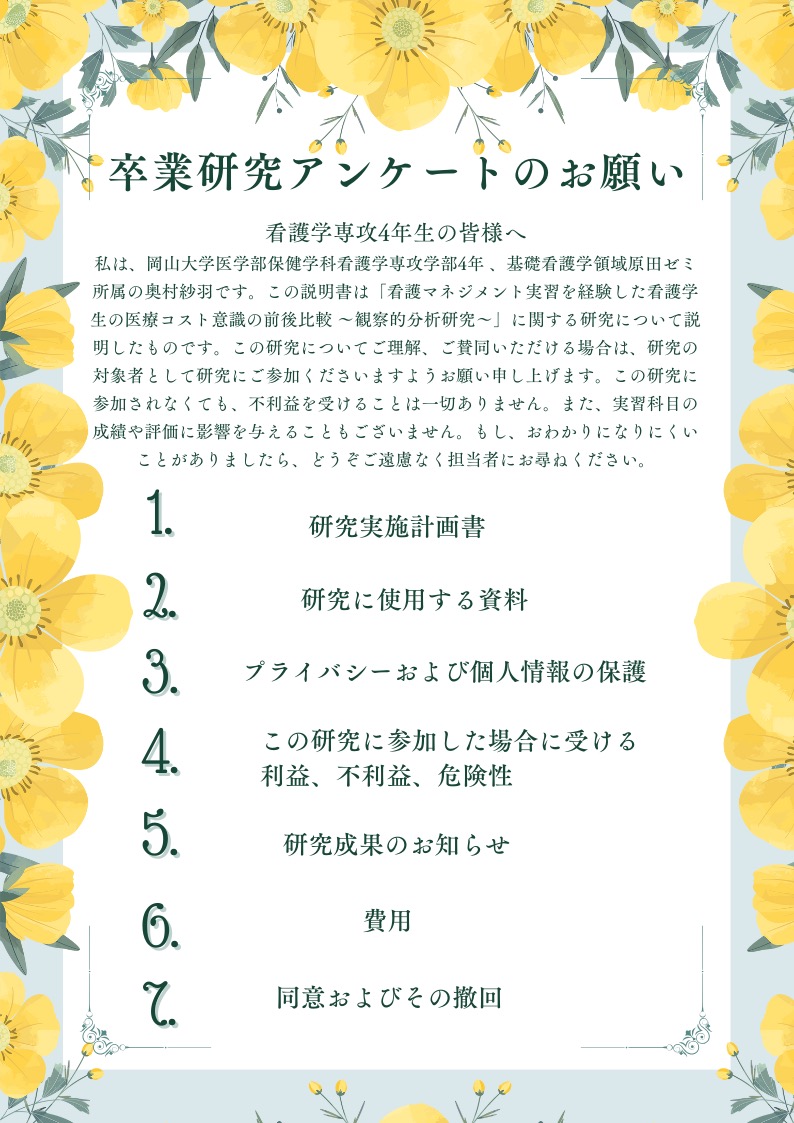
To fourth-year nursing students
My name is 奥村紗羽. I am a fourth-year nursing student in the Department of Health Sciences, Faculty of Medicine, Okayama University, and a member of the Harada seminar in Fundamentals of Nursing. This notice explains an observational study comparing nursing students’ awareness of healthcare costs before and after a nursing management practicum. If you understand the study and agree to take part, we invite you to participate. There is no disadvantage if you decline, and your choice will not affect your practicum grade or evaluation. If anything is unclear, please ask the person responsible for the study.
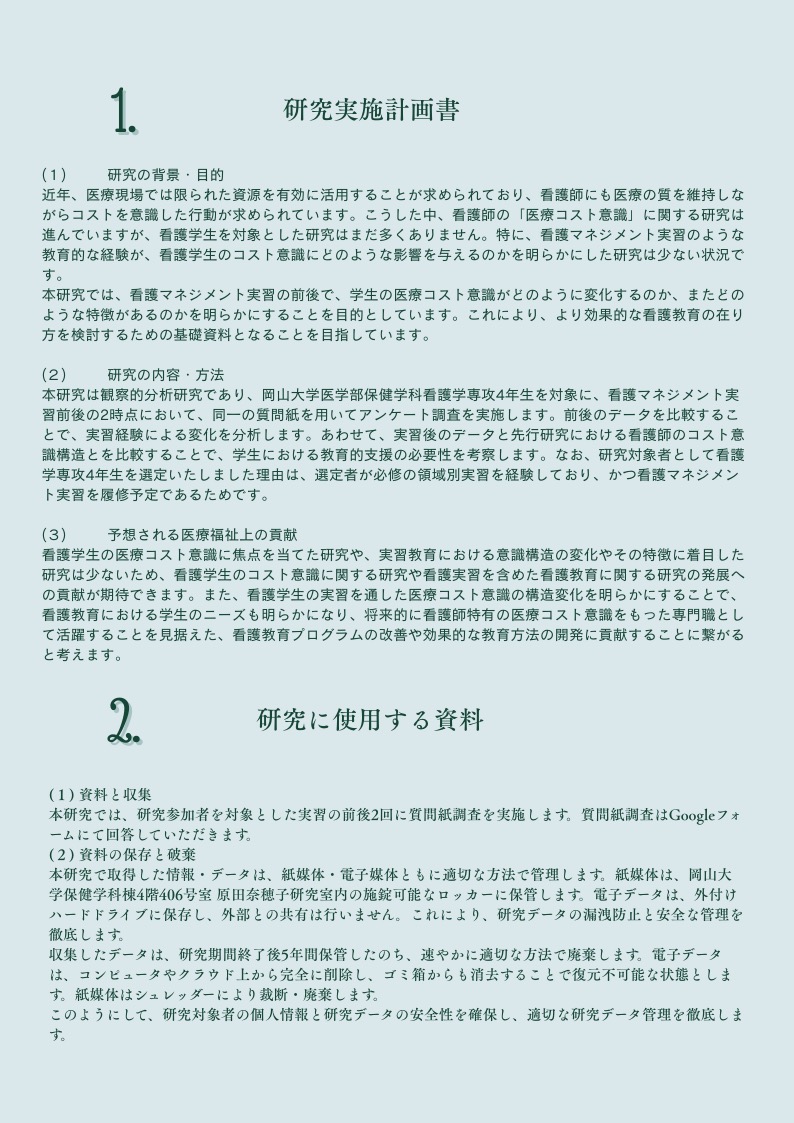
1. Study protocol
Background and objectives
Healthcare providers need to use limited resources effectively. Nurses are expected to be aware of costs while maintaining quality of care. There is research on nurses’ awareness of healthcare costs, but relatively little on nursing students, particularly on the effects of educational experiences such as the nursing management practicum. This study examines whether and how students’ awareness of healthcare costs changes before and after the practicum. Its aim is to provide evidence for considering more effective approaches to nursing education.
Methods
This observational study uses the same questionnaire with fourth-year nursing students at Okayama University at two time points, before and after their nursing management practicum. We will compare the responses to examine changes associated with the practicum. We will also compare post-practicum responses with the structure of nurses’ cost awareness described in previous research to consider what educational support students need. Fourth-year nursing students were chosen because they have completed their required specialty practicums and are scheduled to take the nursing management practicum.
Expected contribution
Few studies focus on nursing students’ awareness of healthcare costs or how it changes during clinical training. The findings may contribute to research on cost awareness and nursing education, including clinical practice. They may help identify students’ learning needs and improve programs and teaching methods that prepare future nurses to consider costs in their professional practice.
2. Study data
Participants will complete two Google Forms questionnaires, one before and one after the practicum.
Paper records will be kept in a lockable cabinet in the Harada Laboratory, Room 406 on the fourth floor of the Faculty of Health Sciences building. Electronic data will be kept on an external hard drive and will not be shared outside the research team. The study data will be kept for five years after the study ends and then disposed of promptly. Electronic copies will be permanently deleted from computers, cloud storage and trash folders, and paper records will be shredded.
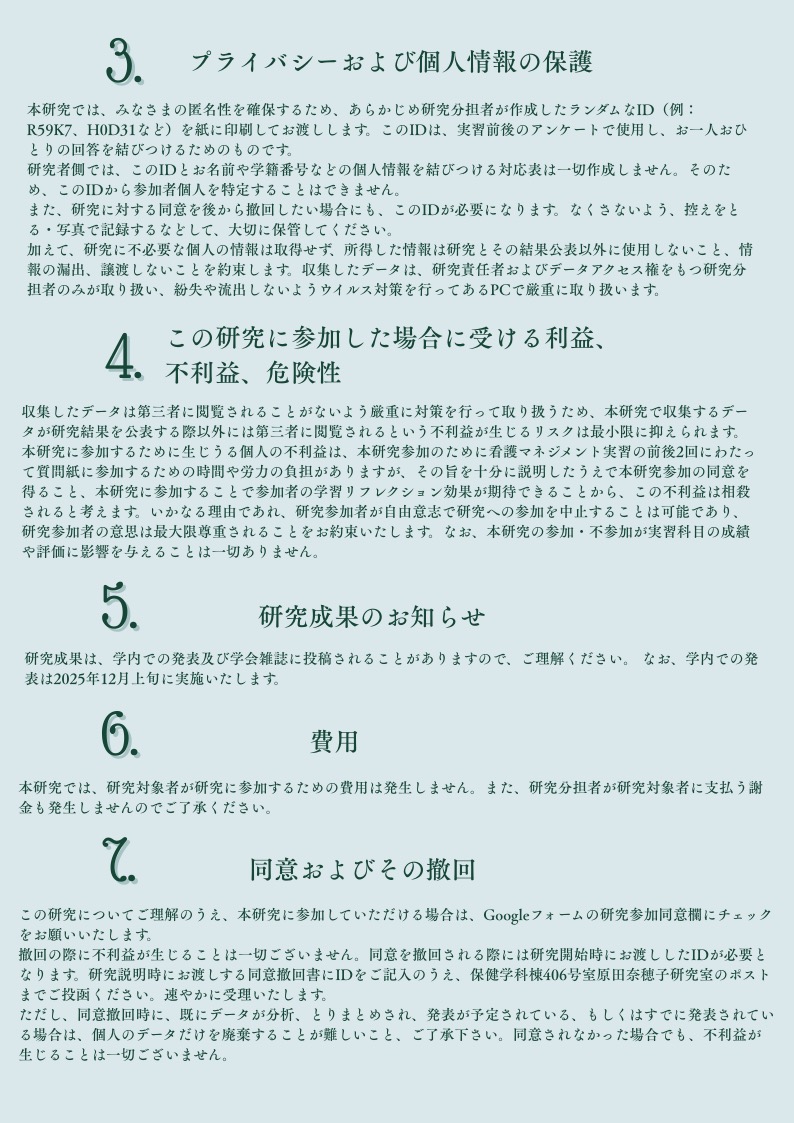
3. Privacy and personal information
To protect anonymity, a researcher will give you a randomly generated ID printed on paper. You will use the same ID on both questionnaires so your responses can be matched. The researchers will not create a list that links IDs to names or student numbers, so they cannot identify you from your ID. Keep a copy or photograph of your ID, as you will also need it if you later withdraw consent.
The team will collect only personal information needed for the research. The information will be used only for the study and publication of its findings and will not be disclosed or transferred. Only the study lead and researchers with data access will handle it, on a computer with antivirus protection.
4. Benefits, burdens and risks
The team will protect the data from access by third parties and minimize the risk of disclosure outside the publication of research results. Taking part involves time and effort to complete two questionnaires. This burden will be explained before consent is obtained. The researchers expect that participation may help students reflect on their learning. Participants may stop at any time for any reason, and their decision will be respected. Participation or nonparticipation will not affect practicum grades or evaluations.
5. Sharing the findings
Findings may be presented at the university and submitted to a journal. The university presentation was scheduled for early December 2025.
6. Costs
There is no cost to take part, and no payment will be made to participants.
7. Consent and withdrawal
If you understand the study and agree to take part, check the research consent box in the Google Form. You may withdraw without disadvantage. To withdraw, write your study ID on the withdrawal form provided when the study was explained and place it in the Harada Laboratory mailbox at Room 406 in the Faculty of Health Sciences building. Your request will be processed promptly.
It may be difficult to remove an individual’s data if the data have already been analyzed and compiled and a presentation is scheduled or the results have already been presented. Declining consent carries no disadvantage.
Contact
Professor Nahoko Harada, Okayama University, 2-5-1 Shikata-cho, Kita-ku, Okayama, Faculty of Health Sciences building, Room 406. Phone and fax: 086-235-6894. The information sheet was published on the original lab website.
Original Japanese information sheet